

Version 6.2 includes the following new repertories:
Therapeutic Guide by G.H.G. Jahr and Plant Table by Michal Yakir
The following modules have been updated: Safe Repertory 10
When the programme size is changed, the internal window sizes are now automatically adjusted.
The drop-down menus for rep and MM selection now show more entries.
The search still only starts after at least 2 characters have been entered.
However, entries of one character are then also found, e.g. < for agg.
Entries are now displayed in the patient list after they have been created.
The patient list can be password protected.
In the evaluation, several categories can be weighted more or less using the context menu.
Medicines that are not included in the evaluation are now also saved.
The number of hits is now displayed in the category display.
Various new functions for the extended Rückert, the new symptom lexicon.
And many small improvements here and there…
Version 6.1 includes a new module: Mohinder Jus’ Practical Materia Medica as MM and Repertory!
The following modules have been updated: Rückert Module & Safe Repertory 10
New internal consultation window
When searching in the MM and in the rubric display, all hits are now highlighted in yellow.
Remedy filter now also available for multiple positions
Combination dialogue always at the top and now for up
Improved author filter also for remedies without an author
Search for remedies by valence now with the number of remedies in the repertory
And many small i to 9 rubricsmprovements here and there…
Version 6.0 includes the Saine Repertory 2024 and the pocket card index by Bernd von der Lieth as new modules.
The following modules have been updated: Complete 2024 with Saine supplements, Safe Repertory 8, Colour Repertory
All Materia Medicae entries as rubrics at the end of the respective repertory file (a total of + 300,000 “rubrics”), which can be activated in the search across all repertories
Now up to 20 external repertories & MMs
Author filter can be disabled, remedy filter for multiple remedy abbreviations
Evaluation copy with the first remedies as a tabular table
Simplified activation: Only 1 key now 🙂
Chronological sorting of modules, uniform revision of repertory information
The instructions have been revised
And many small improvements here and there…
Version 5.5 includes a new module, mmpp Genius Symptoms, and links to the homeopathic link system Sat.
The following modules have been updated:
Complete 2023, Yingling Repertory, Safe Repertory 5, Cancer Repertory, Colour Repertory, Minimal Materia Medicae 1&2
It is now possible to start with the patient list open.
PDF files (for findings, etc.) can now also be displayed in the patient list.
The consultation duration is now also saved here.
The hierarchical search display has been improved.
The additional line in the evaluation can now be hidden.
The options in the settings window have been arranged more clearly.
The instructions have been revised.
And many small improvements here and there 😉
Version 5.4 now allows for easy transfer without evaluation using -,
a simple way to turn RA-CK-SA symptoms into collectives,
improvements to the rubric and consultation editor, and the combine function.
Version 5.3 now includes remedy numbering in the rubric editor according to the evaluation,
the mental illnesses of G.H.G Jahr and the handbook by Noack and Trinks.
Version 5.2 includes a search function in the patient list,
the rubrics can now be moved with the mouse in the evaluation,
the remedy search by value primarily shows the first remedy in the evaluation,
the comparative remedy search primarily shows the first two remedies in the evaluation,
the remedy filter in the rubric editor now also finds synonyms, etc.
The version contains the clinical indications of G.H.G. Jahr with the dictionary of historical terms.
Version 5.1 includes an optional medicine display in the category list,
an NOT search with ! to exclude character strings from the search,
and a new RTF editor for notes and consultations.
In the evaluation, columns can now also be marked by clicking on them.
The version contains the Complete Repertory 2021.
The 1905 BBCR has been supplemented with the posthumous 1937 edition in German translation.
The entire programme code has been optimised.
Version 4.4 contains the Complete Repertory 2020
and a comprehensive update of the Safe Repertory with additions by Mohinder S. Jus, among others.
Version 4.3 now contains a section in all repertories for visual separation in the evaluation.
Various designs can be selected for the user interface. PDF display is working again.
Version 4.2 includes the Predictive Repertory CH and the cough module by Jens Ahlbrecht.
An app is now available for Android smartphones and tablets, which can also be used offline.
Version 4.1 integrates the Complete Repertory 2019 with selectable authors.
It also includes Boericke’s Materia Medica, Yingling’s Handbook of Obstetrics and Jahr’s Skin Repertory.
The hay fever module has been updated to the current 2019 version.
The hits in the rubrics can now be highlighted in colour if desired, consultations can be saved in the patient list, and the settings can be used to select which repertories should be loaded at startup.
In version 4.0, the Complete Repertory 2018 with selectable authors has been integrated.
jRep can now also work with relational data sets, hence the version jump to 4.0.
In addition, the drug descriptions from the Pure Drug Theory, Chronic Diseases and
Stapf’s Archive have been integrated.
In version 3.8.2, a search function for all medicines was integrated.
In addition, the printout can be split so that more medicines can be printed.
In version 3.8.1, a combined AND/OR search was implemented.
In version 3.7.7, the option of multiple selection and easy combination from the category list was implemented.
In addition, the patient list now sorts the latest evaluations at the top and can import images from the clipboard.
In the additional MM window, it is now also possible to search for spaces using _.
In version 3.7.6, additional magnification levels for high-resolution screens were integrated.
In version 3.7.5, the Kent was supplemented with the Künzli points.
The Kent is included in version 3.7.4.
Comments are now finally possible in your own repertories.
The Materia Medicae can now be selected with ‘speaking’ letters.
Version 3.7.3 includes Kent from OpenRep, which no longer runs under the current Java.
The new version also contains a significantly more comprehensive hay fever repertory.
Version 3.7.2 includes Rückert’s Systematic Presentation as a repertory.
In addition, you can jump back via the context menu in the Materia Medica windows.
Java has been integrated into jRep for Windows and MacOS, so it no longer needs to be installed separately.
With version 3.7.1, previous evaluations can be opened in a separate window for comparison using Ctrl+Q.
The search function has been fundamentally revised in version 3.7:
Any number of search terms can be entered,
upper and lower case letters can be mixed, e.g. to restrict the search to individual CHAPTERS
Umlauts are found using the corresponding vowels: a also finds ä, e.g. skin rash also finds skin rashes
Placeholders: ? for one character, * for multiple characters
Switchable OR search
The evaluation, rubric display and MM windows can now be easily copied to the clipboard as graphics using Ctrl+C.
In version 3.6.2, the loading of repertories at start-up has been significantly accelerated.
The hierarchical search can now also be navigated using the arrow keys.
Changing the programme font size now also affects the rubric display and the materia medica windows.
The rubric displays have been uniformly revised in almost all repertories, which means that the programme requires less storage space.
From version 3.6.1 onwards, it will show when a new update is available for download.
In addition, evaluations etc. can now be easily synchronised between different computers using a USB stick.
In version 3.6, the remedy abbreviations for changed rubrics are also linked to the materia medica.
The link now always leads to the remedies from the currently set materia medica.
In version 3.5.3, relative contraindications can be enabled or disabled in the settings (Ctrl+J).
In addition, older external files can be overwritten by newer ones during an update.
Version 3.5.2 now also takes relative contraindications into account.
The patient list now displays the number of patients in each patient group.
With the time repertory, jRep now contains all of Boger’s repertorial works.
Roland Methner has allowed me to include his cancer repertory, thank you!
With version 3.5, your patients can also conveniently fill out the questionnaires online.
In version 3.4.4, the alternative sources of the remedies are displayed.
When changing rubrics, deleted remedies are now also displayed.
In version 3.4.3, the search function has been revised so that additional special characters can be found.
In version 3.4.2, you can display your own PDF files with remedy information
in the Materia Medica windows (e.g. Hering’s leading symptoms from Till-Verlag).
Version 3.4 now includes the much-requested search option across all repertories (Ctrl+A).
In addition, it is now possible to search for multiple character strings in the additional Materia Medica window (Ctrl+Z).
Furthermore, the display of supplemented and customised rubrics has been improved, and much more.
The number of module slots has been increased to allow for the inclusion of additional works.
This means that new activation keys are required – hopefully for the last time.
Version 3.3 includes Boger Bönninghausen’s Characteristics and Repertory (BBCR) from 1905 and the Miasmatic Pocketbook 2011.
We have also decided to make jRep-Web available to all customers free of charge.
Inspired by the book ‘Homöopathische Fallanalyse’ (Homeopathic Case Analysis) by Gerhard Bleul (whose
A-F courses I attended at the time), I have implemented Jan Scholten’s periodic table as a module.
I have also incorporated Heiner Frei’s new questionnaires –
in addition to the old ones on which the cases in his old books are based.
Thanks to Roland Kauke’s collaboration, jRep now includes G.H.G. Jahr’s comprehensive symptom codex, in which Jahr’s annotations have been highlighted in colour, making it immediately apparent which symptoms have been verified and which have only been clinically observed.
I have been asked about this repeatedly for a long time, and now it’s finally here:
Phatak’s Repertory and Materia Medica are on board!
Stephan has massively accelerated the search once again, so that larger repertories are now also possible.
For version 3.2, Stephan developed a form module, and Heiner Frei allowed me to use it to implement his questionnaires.
This allows you or your patients to fill out his questionnaires on the computer with a click of the mouse, and jRep generates the corresponding evaluation for you!
Imagine a patient calls you and briefly describes the issue.
Meanwhile, you call up the patient in jRep and select a suitable questionnaire, which you can fill out together with the patient on the phone.
You no longer need to take notes or think about what else you could ask.
Instead, you simply click on the appropriate symptoms.
Then you open the evaluation generated by the form and apply Heiner Frei’s optimised polarity analysis…
In the course of this, I converted the Therapeutic Pocketbook into a hierarchical file and added relevant additions from Dunham’s BBCR to optimise the polarity analysis, marked accordingly – with jRep, this is no problem at all 🙂
While I was at it, I also generated a synthetic materia medica of the Genius symptoms from the pocketbook.
And then, thanks to the energetic support of Dorothea Dittmann, Sigrid Klingenstein, Michaela Kieffer and Vera Wüst, I have finally implemented the repertorial part of Boger’s Synoptic Key – separated into the 1st and 3rd (supplementary) parts.
The SK Materia Medica was linked together in the process, as was the Bhanja Masterkey.
For a long time, I have wanted to be able to quickly repertorise a few symptoms without first having to use a full-fledged computer and boot it up. As a user of various pocket computers, I had in mind a small repertorisation programme that would also run on such a device.
When I learned about the Bönninghausen method during the three-month course in Augsburg in 2005, I found a suitable basis for this in the “Therapeutic Pocketbook of 1846”. However, the programme should also allow me to expand this ingenious approach, e.g. with additional remedies, rubrics and notes.
So that the same programme could be used on different devices, I thought early on about a cross-platform Java programme – but I soon received the well-intentioned advice not to try to programme this myself, as Java is a complex programming language that needs to be mastered.
So I set out to find a programmer who would be willing to fulfil my wish. At the beginning of 2006, I came across a description of pDict, a foreign language dictionary that runs on Java, on an early German-language smartphone homepage. It seemed to me to be the right programme for my project, allowing me to look up symptoms instead of foreign words. All it needed to do was be able to take over categories and calculate…
I wrote something similar in an email to the author of the programme on 12 January 2006 and found in Stephan Räss a gifted programmer who not only implemented my ideas within a very short time, but also contributed numerous ideas of his own – initially without any prospect of adequate remuneration. Thanks to him, what started out as a small tool for use on the go has now become a very powerful repertorisation programme with a multitude of innovations.
In addition to him, my (and hopefully also your) thanks go to our families, whose understanding, patience and forbearance made this project possible in the first place.
After the release of version 1.0 in April 2006, Bernd von der Lieth from Hamburg approached me (many thanks to Michael Teut) to contribute his homeopathic works to jRep. [Now published by Jens Ahlbrecht’s Ahlbrecht-Verlag.] This makes jRep the first homeopathy programme to include not only Bönninghausen’s “Therapeutic Pocketbook” but also his expanded Materia Medica, which is “intended to be used in conjunction with my repertories”.
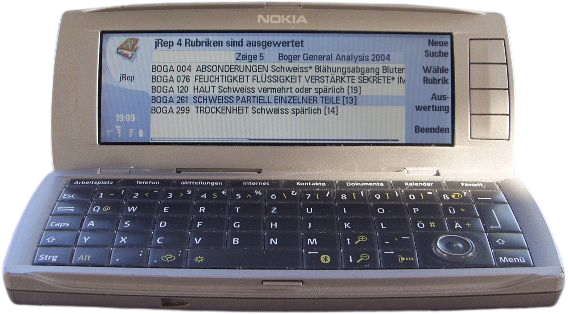
One year later, just in time for Hahnemann’s 252nd birthday, I was proud to finally present version 2.0, which Stephan had completely reprogrammed since early 2007 and which included a variety of new modules and features, such as table evaluation, rubric comparisons, polarity analysis, a print function, and much more.
At the inspiring Boger Symposium in Karlsruhe in 2007, I was delighted to release version 2.1, which, in addition to numerous minor improvements and the comparative rubric search, included new modules such as Boger’s “Remedies for Tonsillitis etc.” and Hahnemann’s Organon paragraphs from the 6th edition.
We then implemented a number of customer requests and an improvement to the polarity analysis according to Dr Heiner Frei with sorting by
- Completeness of symptoms,
- Exclusion of contraindications and
- Sum of polarity differences
this takes you straight to the decisive final results! (All of his sample cases can also be solved with the 1846 edition of the Therapeutic Pocketbook, which is included in iRep 🙂 Then Stephan surprised me with the search function in the additional Materia Medica window, and my Würzburg teacher, Dr. Joachim Stürmer, provided me with his new ingenious ‘minimal materia medica’ as an additional module. All these innovations led to the release of version 2.2.
Then I moved to Rottenburg because I had been working as a homeopathic doctor at the Hahnemann Clinic since 2007. And Stephan once again programmed at an incredible speed, making many improvements and creating an editor that now makes it very easy to change and add to existing rubrics and even create new ones! In 2008, I finally made it and visited Stephan in beautiful Bern (see picture above). I was a little nervous, as we had only been in contact by email since January 2006! But we and our families got along really well 😉 And then I visited Mrs Flury and discussed with her how her late husband’s practical repertory could be implemented. All in all, we had a great short holiday on the Aare (the river that flows through Bern).
Gienow’s miasmatic model already inspired me during my training with Ansgar Schimmöller in Bayreuth. In 2006, I met Peter Gienow and his wife Gertie at a seminar in Detmold. He was immediately enthusiastic about jRep, partly because it is one of the few homeopathy programmes that runs on Linux, and gave me the file of his Miasmatic Pocketbook (based on the works of Bönninghausen and Boger) for conversion into a programme module. Nevertheless, it took four gruelling attempts (every time I was almost finished with the conversion, a new edition appeared…) before it was finally completed in 2009. Stephan programmed a hierarchical search function and integrated a convenient editor to make it easy to design your own materia medica files.
At the end of 2009, Jens Ahlbrecht and Peter Busch introduced me to the works of G.H.G. Jahr, which are now gradually being integrated into the programme. Thanks to the tireless digitisation work of Gaby Schmidt, we are now able to present the Handbook of Principal Indications, which Hahnemann praises in his footnote to §153. In addition to many improvements, Stephan has programmed a small patient management system.